Monday, July 26, 2010

Nathalie Djurberg


1. Claymation is a term coined in reference to any film in which the context is majorly plasticine or a similar substance.

2. I believe what is meant by the term is that we all have a pre conceived idea of what the Garden of Eden should look like and our 'natural' thinking of this is challenged so much so that it seems surreal when in fact the idea of our Garden of Eden has no more truth than that of Nathalie's.

3. The complexity of emotions are caused because of the innocence of the materials used and the actions that the characters perform. Automatically Claymation is referenced in our mind to children and we think of children viewing these. So when we so strongly, before we have even viewed it expect it to be viewed by a child we ourselves are put into the mindset of a child. Therefore when we see something completely opposite we are shocked and appalled even as we were not prepared mentally.

4. Well basically the way in which she used children's materials to create her work creating a sense of innocence a we link claymation directly to children, moreover, children are directly linked to innocence.

5. I think this has come about because people like to shock and disturb the viewer. This has always been relevant to artists but turning the innocent into something disturbing is just a newly explored way in which artists can achieve this. One artist explored it and a lot have followed.

6. Djurberg's
work is interesting because of the pure grotesque quality of the clay she uses.
It is reminiscent
of thick
blood. I think the 'shock' value of her work is simply more shocking than that
of other artists
imploring
similar tactics.

7. Djurberg's work was really interesting I
found it humorous but at the same time pretty disgusting.

Sunday, May 23, 2010

Memorial Project Nha Trang

The 'Memorial Project Nha Trang By Jun Nguyen-Hatsushiba Is a 13 minute video instillation set in an underwater Vietnam sea. It depicts actual fishermen of the country dragging rickshaws along the ocean floor. This somewhat mundane task is made interesting by the music, which the artist himself has composed and the physical struggles and dangers of the fisherman and there every day job. You can feel the struggle of these men and as you watch there faces remain calm untill there lungs cannot hold any longer and the kick towards the surface. There is an eerie feeling as all you can hear is the music and bubbles. The viewer is put into a sub-marine if you will, observing these strange creatures with there antique contraptions and there bizarre strenuous task.

I find relations from this video instillation and the way in which some countries have been affected badly by Modernist values. Vietnam in its self is facing the very difficult burden of the past in the face of modernization. As now in western countries huge boats are contracted to trawl the ocean floor and it is effective bringing thousands of fish with every trawl. But these men and the people of the Vietnamese have to struggle Physically and emotionally every day in order to live. These ideas of Nguyen-Hatsushiba not only apply to the fisherman of Vietnam but to the vast majority of all families and adults in which ever profession they choose. Notably a lot of european clothes made for big commercial companies are made by under paid Vietnamese women and children whom are made to work in very poor conditions.

Although the negatives of Modernism are very harshly affecting the every day lives of Vietnamese people there are some positives. Firstly Vietnams environment or at least, ocean floor has remained natural and undisturbed by western ocean trawlers which literary destroy everything in their paths. As i view this video Nguen-Hatsubishas ideas and concepts of this video are somewhat lost n me as the men seem content and almost at one with their countries environment. Although a struggle for air takes over their otherwise calm, cool and peaceful expressions I cannot help but feel jealousy almost as these men are able to use there bodies and be with nature as many of the western population strive for a life similar to that. Living off the land. Naive as it sounds.


Monday, April 26, 2010

Landscape and the Sublime


1. The enlightenment was an intellectual movement during the 18th century, in its simplest sense it was the creation not necessarily of a new framework of ideas but rather a framework or set of values amongst men. These values were base on themselves(human nature), society and nature its self. These new values challenged the traditional concepts and values which in the past were predominantly based around Christianity.

2. Sublime is derived from the latin word Sublimis which literally translates to; looking up from under the lintel, high, lofty, elevated, exalted. it is the quality of vast greatness or magnitude in many senses of the word, whether physical, moral, intellectual, metaphysical, aesthetic, spiritual or artistic. In particular it tends to be referred to as a greatness in which nothing else can be compared.

3. The concept of the sublime came out in the enlightenment period as the artists of the time had a new set of values. One being the new found recognition of the beauty in nature. Seeing the beauty British writers, taking the 'GrandTour' in the 17th and 18th centuries, first used the sublime to describe objects of nature.
http://en.wikipedia.org/wiki/Sublime_(philosophy)

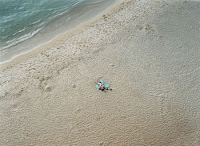
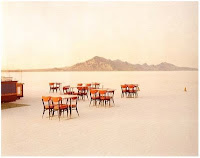
4. Richard Misrach's photography is typically of landscapes or seascapes and usually includes people or man made objects. He studies the landscape and man’s complex relationship to it. The people or objects in his photographs are tiny compared to the vast sea or landscapes.

5. Augustus Earle, Viviano Codazz, Max Podstolski

6. Misrach's photography gives me a god like feeling or upper being, looking down on people as small an insignificant compared to the vast magnitude of nature. The people seem very vulnerable and powerless to the forces of nature. The pieces impart a dark frame of mind upon me. I think of the world and mankinds correlation as foolish and ignorant. Evidence of this ignorance is broadcast to the world every day on the News. This news showing the force of nature so easily overpowering cities and towns and taking the lives of people, just as easily as we humans take from nature everyday, so too nature just as easily takes from us.

Although Misarch's pieces are very aesthetically pleasing, bright, beautiful and tranquil. I can not shake the feeling of depression as I look down on (from what seems the eyes of god) unworthy and ungrateful humans. The feeling of depression is drawn from my own guilt as I know I too am guilty of the above crimes against nature.

7.

Thursday, April 8, 2010

Damien Hirst


The work of Damien Hirst relates to the artist and the economic system of the renaissance period. Originally part of the YBA (young British artists) he led the movement of conceptual art in Britain in the early 90s.

The artists commonly used shock tactics and had fresh new ideas . Hirst particularly pushed away from the traditional art of Britain in the 90s and his exhibition, 'the physical impossibility of death in the eyes of someone living' was exemplary and similar to the acts to the Renaissance artist of the time. Comparably pushing away and thinking for themselves as to what art is? In the same way the role of the painter and the sculpture of the Renaissance period, (traditionally thought of in the lower social role of the crafts person) wanted their profession to be recognised as a member of the liberal arts, Damien Hirst and the YBA wanted their art to be recognized as a true artists movement in Britain at the time.


His work 'For The Love of God' a platinum cast of a human skull encrusted with 8,601 flawless diamonds, including a pear-shaped pink diamond located in the forehead. Costing £14 million to produce, it is an interesting look into modern mercantilism. The idea of mercantilism was for a nation to increase imports and collect precious metals in order to best serve wealth and power in their given country. I find that Hirst's persona is somewhat arrogant and flamboyant, a prime example of his flamboyancy is his skull, the most costliest piece of art in history, it relates to the idea of precious metals being collected for ones nation. Relating to the saying 'no man is an island' which clearly doesn't apply to Hirst. I believe Hirst makes the statement that man is his own nation in particular the rich. Collecting and spending and growing as we all constantly are as individuals, some more so than others. As his critics have commented on; "work of art? He is not an artist. It's all commercial value to him. Is this just another way for rich people to deal with their time and excess of money. If Paris Hilton or Ali G say they did it, instead of Hirst, would you call that art? or just another publicity stunt?"
http://www.blogger.com/post-edit.g?blogID=5721243092885760241&postID=8586704498988537630


I believe that Hirst makes clever observations on society with His Art, 'For the Love of God' in particular commenting on the social status of individuals in today's society.

Tuesday, March 2, 2010

Auckland Triennial 2010

1. The theme of the 4Th Auckland Triennial is based on the impulse of risk and adventure in art today.


2. A 'Curator' is a content specialist for a gallery's collection. The curator will often take care of the collections, make the decisions regarding what objects to collect or put up for an exhibition. Also conduct research based on the collection, and share that research with the public and/or scholarly community through exhibitions and publications.


3. Australia, New Zealand, U.S.A.


4. Biennial of Sydney.


5. Nick Austin, Richard Bell, Sharon Hayes, Alex Monteith.


6. Mother's Tankstation, Life Again. Light Again. Leaf Again. Love Again, Garret Phelan.


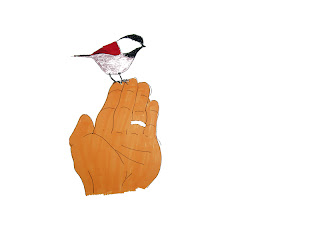
This exhibition by garret Phelan is drawn from an obscure 19h century text on bird watching. In this exhibition he combines his passion for sound, drawing and bird watching to create the possibility of a mutated bird species into Ireland's environment. The pictographic drawings have both a humorous intent, as well as a serious darker side. Imagine a world where birds are forced to 'evolve' because of humans destructive negligence towards the ecological environment. Although this seems unlikely, it does have an affect on the way we look at nature today.

http://www.garretphelan.com/


7. Personally Phelan also creates an 'absence' of the sound and sight of birds in nature to enter my mind, I find it hard to picture native birds of New Zealand being forced to evolve and mutate in order to adapt to a change in the ecological environment caused by fellow negligent 'Kiwis'. In creating this 'absence' Phelen forces us to look at the potentially horrible effect that human negligence towards nature can largely or rather will largely have on the greater population of birds in all countries of the world. maybe not to the extreme point of mutation but the thought is drilled into our minds and conscience. The automated (evidently false) love of nature installed in all New Zealander's from birth is challenged, as we are forced to look at our blatant carelessness towards the thing we as 'kiwis' all hold precious in our selves, our countries image.